
- This event has passed.
David Berube – Hazard Communication | GES Colloquium
Colloquium Home | Zoom Registration | GES Video Library (current) | Video Archives | Podcast | @GESCenterNCSU | Newsletter
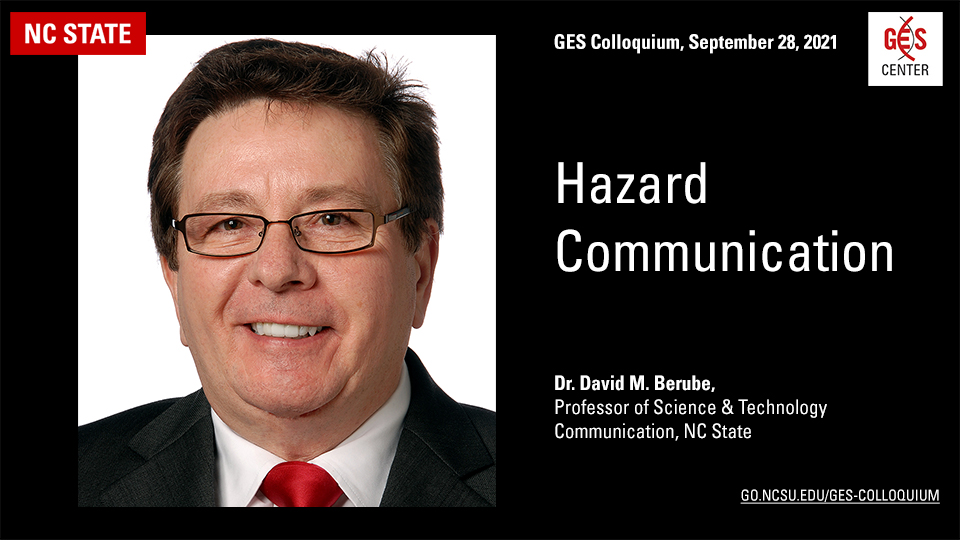
Hazard Communication
Dr. David M. Berube, Professor of Science & Technology Communication, NC State
Hazard Communication refers to communication to a limited group of stakeholders and involves three variables: hazard data, dosage data, and exposure data.
Abstract
This presentation tries to separate data sets associated with Hazard Communication from those associated with Risk Communication. Since Risk Communication is a social construct, it involves public understanding of science while Hazard Communication generally does not. Hazard Communication occurs between field experts while Risk Communication include experts and inexperts. Experts share biases with the public in some cases but not in others. For example, innumeracy and probability neglect tends to be associated with inexpert audiences. This paper will be presented to the National Toxicology Program for which I serve as a member of their Board of Scientific Counselors.
Related links:
- Dror, I. E. (2020). Cognitive and Human Factors in Expert Decision Making: Six Fallacies and the Eight Sources of Bias. Anal. Chem. 92. 7998-8004
- Howard, J. (2019). Cognitive Errors and Diagnostic Mistakes: A Case-Based Guide to Critical Thinking in Medicine. Basel, Switzerland: Springer International Publishing AG.
Speaker Bio
Dr. David M. Berube (NYU 1990) is a Research Professor and a GES Fellow at North Carolina State University (NCSU) in science/technology communication. He teaches graduate seminars in risk, fear, disaster, and climate change science communication. He received over $20 million in grants over the last two decades studying science communication, especially intuitive toxicology. He wrote Nano-Hype (2006), edited another on Pandemic Communication and Resilience and is writing a book on Lessons We Should Have Learned from Zika. He is the director of the Public Communication of Science & Technology project and social science director of the Research Triangle Nanotechnology Network involving NCSU, Duke and UNC. He authored some White Papers on social media and risk. He is a member of the Society of Toxicology and Special Government Employee for the Board of Scientific Counselors for the National Toxicology Program.
GES Colloquium is jointly taught by Drs. Dawn Rodriguez-Ward and Jen Baltzegar, who you may contact with any class-specific questions. As conditions allow, colloquium will be held in-person in Poe 202, as well as live-streamed via Zoom. Please subscribe to the GES newsletter for updates (links above).
WordPress database error: [Unknown column 'wp_tec_occurrences.start_date' in 'SELECT']SELECT SQL_CALC_FOUND_ROWS wp_posts.*, CAST( wp_tec_occurrences.start_date AS DATETIME ) AS event_date
FROM wp_posts LEFT JOIN wp_term_relationships ON (wp_posts.ID = wp_term_relationships.object_id) LEFT JOIN wp_postmeta ON ( wp_posts.ID = wp_postmeta.post_id AND wp_postmeta.meta_key = '_EventHideFromUpcoming' ) LEFT JOIN wp_postmeta AS mt1 ON ( wp_posts.ID = mt1.post_id )
WHERE 1=1 AND wp_posts.ID NOT IN (16535) AND (
wp_term_relationships.term_taxonomy_id IN (149,521,802)
OR
wp_term_relationships.term_taxonomy_id IN (45,47)
) AND (
wp_postmeta.post_id IS NULL
AND
( mt1.meta_key = '_EventStartDate' AND CAST(mt1.meta_value AS DATETIME) >= '2026-04-12 22:47:03' )
) AND wp_posts.post_type IN ('post', 'page', 'attachment', 'tribe_venue', 'tribe_events', 'tribe_event_series') AND ((wp_posts.post_status = 'publish'))
GROUP BY wp_tec_occurrences.occurrence_id
ORDER BY event_date ASC, wp_posts.post_date ASC
LIMIT 0, 3