
- This event has passed.
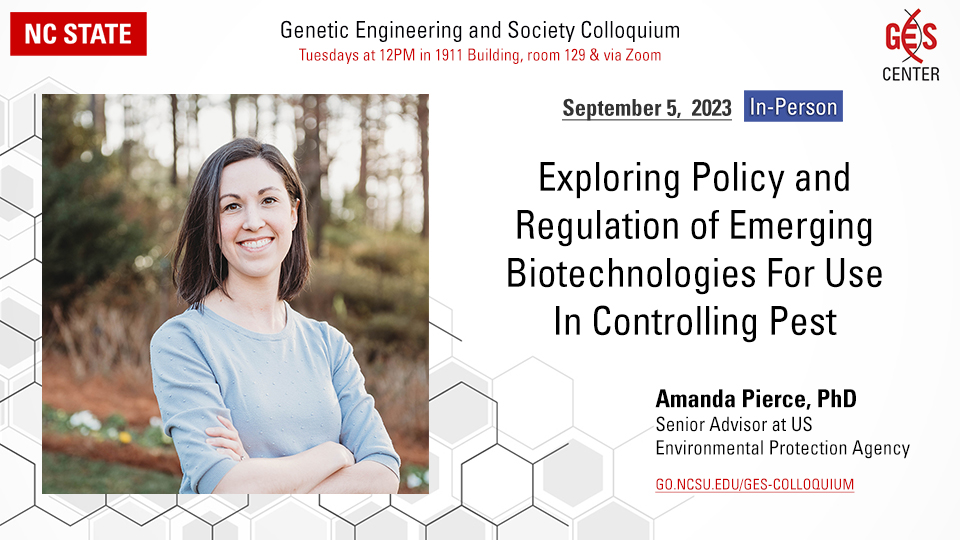
Amanda Pierce—Exploring Policy and Regulation of Emerging Biotechnologies For Use In Controlling Pest Populations | GES Colloquium
Colloquium Home | Zoom Registration | GES Video Library (current) | Video Archives | Podcast | @GESCenterNCSU | Newsletter
Exploring Policy and Regulation of Emerging Biotechnologies For Use In Controlling Pest Populations 
Amanda Pierce, Senior Advisor at US Environmental Protection Agency (EPA)
Discussion of EPA’s role in the regulation of biotechnology and the development of policies and regulations for emerging technologies.
Related comments in this June 2023 opinion piece from Jennifer Kuzma in Science, EPA decision to tighten oversight of gene-edited crops draws mixed response.
Abstract
The U.S. Coordinated Framework for the Regulation of Biotechnology describes the comprehensive federal regulatory policy for ensuring the safety of biotechnology products with the goal of protecting health and the environment without impeding innovation. Under the framework, EPA, FDA, and USDA aim to cover the full range of plants, animals and microorganisms derived from biotechnology in an integrated and coordinated manner. The Office of Pesticide Programs in EPA is responsible for evaluating and ensuring the safety of novel applications of recent discoveries in genetics, molecular biology and other biological disciplines when applied to real world pest control problems – e.g., genetically engineered animals for pest population control and plant-incorporated protectants. In this colloquium, I will explain EPA’s role in the regulation of biotechnology and discuss the development of policies and regulations for emerging technologies.
Speaker Bio
Amanda Pierce is a Senior Advisor in the Emerging Technologies Branch in the Office of Pesticide Programs at EPA where she focuses on advancing ecological risk assessment and policy initiatives for cutting edge biotechnologies within the United States government and internationally. She received her Ph.D. in Population Biology, Ecology and Evolution from Emory University. After a postdoctoral fellowship at the University of North Carolina- Chapel Hill, Amanda became a AAAS Science & Technology Policy Fellow at EPA where she applied her population genetics expertise to developing risk assessment frameworks for emerging technologies.
GES Colloquium is jointly taught by Drs. Jen Baltzegar and Dawn Rodriguez-Ward, who you may contact with any class-specific questions. Colloquium will be held in person in the 1911 Building, room 129, and live-streamed via Zoom.
Please subscribe to the GES newsletter and Twitter for updates.
WordPress database error: [Unknown column 'wp_tec_occurrences.start_date' in 'SELECT']SELECT SQL_CALC_FOUND_ROWS wp_posts.*, CAST( wp_tec_occurrences.start_date AS DATETIME ) AS event_date
FROM wp_posts LEFT JOIN wp_term_relationships ON (wp_posts.ID = wp_term_relationships.object_id) LEFT JOIN wp_postmeta ON ( wp_posts.ID = wp_postmeta.post_id AND wp_postmeta.meta_key = '_EventHideFromUpcoming' ) LEFT JOIN wp_postmeta AS mt1 ON ( wp_posts.ID = mt1.post_id )
WHERE 1=1 AND wp_posts.ID NOT IN (19236) AND (
wp_term_relationships.term_taxonomy_id IN (149,521,802)
OR
wp_term_relationships.term_taxonomy_id IN (45,47)
) AND (
wp_postmeta.post_id IS NULL
AND
( mt1.meta_key = '_EventStartDate' AND CAST(mt1.meta_value AS DATETIME) >= '2026-03-28 14:02:08' )
) AND wp_posts.post_type IN ('post', 'page', 'attachment', 'tribe_venue', 'tribe_events', 'tribe_event_series') AND ((wp_posts.post_status = 'publish'))
GROUP BY wp_tec_occurrences.occurrence_id
ORDER BY event_date ASC, wp_posts.post_date ASC
LIMIT 0, 3