
- This event has passed.
Riley Taitingfong – An oceanic approach to gene drive governance | GES Colloquium (ZOOM)
Colloquium Home | Zoom Registration | GES Video Library (current) | Video Archives | Podcast | @GESCenterNCSU | Newsletter
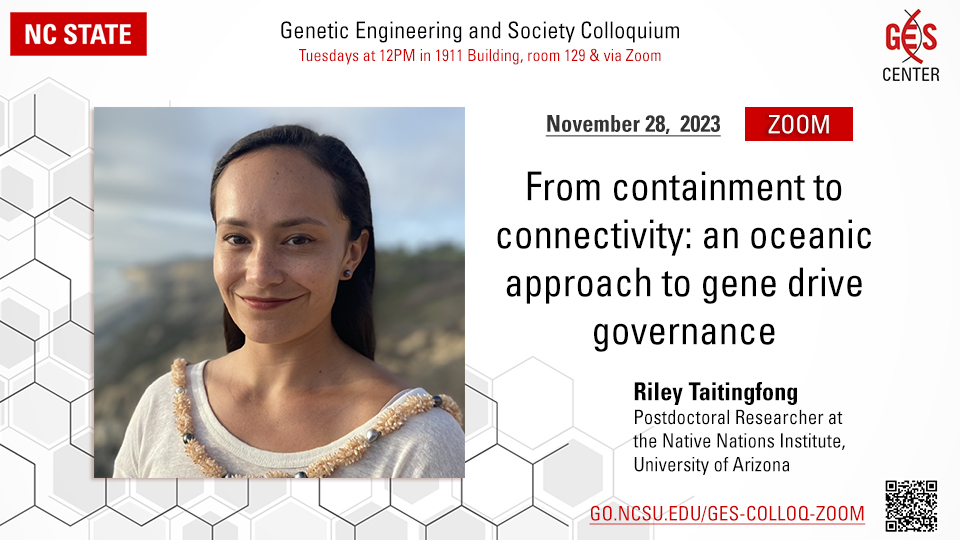
From containment to connectivity: an oceanic approach to gene drive governance 
Riley Taitingfong, PhD, Postdoctoral Researcher at the Native Nations Institute, University of Arizona
Profile | LinkedIn | @riley_ilyse
An exploration of the containment paradigm in gene drive research and discourse, drawing on feminist and Indigenous science studies, and proposes a connectivity-based approach to gene drive governance.
DOWNLOAD SEMINAR POSTER
Abstract
Dr. Riley Taitingfong explores the widespread proposals for implementing novel genetic engineering technologies, specifically gene drives, on islands. Employing an interdisciplinary approach rooted in Communication Studies, Indigenous studies, and feminist science studies, her inquiry delves into how the scientific and regulatory literature supports the assertion that islands are optimal field trial sites for gene drives. The analysis centers on the activation of containment and confinement as crucial concepts that shape the discourse and material practices surrounding the “safe” development and utilization of gene drive-carrying organisms. This spans from enclosed laboratory tests to open outdoor releases, illustrating the intricate depiction of containment as a process accomplished through material infrastructure and stringent protocols. This portrayal stands in contrast to the depiction of confinement as an intrinsic quality of island geographies. Islands are often depicted as naturally conducive to biosafety, absent the constructed structures found in physical laboratories. She argues that the relatively weak operationalization of confinement in island settings stems from deep-seated associations between island geographies and isolation, rooted in colonial imaginaries that historically justified experimentation on both the geographies and peoples of islands. She further contends that the rhetorical emphasis on safety and security in the literature masks the extent to which proposals advocate for displacing risks onto island geographies. In conclusion, Dr. Taitingtong offers strategies and tools for reimagining gene drive governance through oceanic perspectives, rejecting narrow frameworks of isolation in favor of foregrounding connectivity and relationships as essential elements in the ethical governance of science and technology.
Related links:
- Taitingfong, R. I. (2020). Islands as laboratories: indigenous knowledge and gene drives in the Pacific. Human Biology, 91(3), 179-188. PDF (Requires login with Unity ID)
- Taitingfong, R., & Ullah, A. (2021). Empowering indigenous knowledge in deliberations on gene editing in the wild. Hastings Center Report, 51, S74-S84. PDF
- Natalie Kofler and Riley Taitingfong. Advances in genetic engineering test democracy’s capacity for good decision-making. The Boston Globe. (2020). PDF
Speaker Bio
Dr. Riley Taitingfong is a Chamoru researcher and educator working on issues of environmental justice, Indigenous self-determination, emerging technologies, and community engagement. She completed her PhD in Communication at the University of California San Diego, where her project focused on Indigenous governance of gene drive technologies. Riley is currently a postdoctoral researcher with the Native Nations Institute at the University of Arizona, where her projects focus on building practical tools for Indigenous Data Sovereignty. When she’s not working, Riley loves to go birding, paddling, and diving.
GES Colloquium is jointly taught by Drs. Jen Baltzegar and Dawn Rodriguez-Ward, who you may contact with any class-specific questions. Colloquium will be held in person in the 1911 Building, room 129, and live-streamed via Zoom.
Please subscribe to the GES newsletter and Twitter for updates.
WordPress database error: [Unknown column 'wp_tec_occurrences.start_date' in 'SELECT']SELECT SQL_CALC_FOUND_ROWS wp_posts.*, CAST( wp_tec_occurrences.start_date AS DATETIME ) AS event_date
FROM wp_posts LEFT JOIN wp_term_relationships ON (wp_posts.ID = wp_term_relationships.object_id) LEFT JOIN wp_postmeta ON ( wp_posts.ID = wp_postmeta.post_id AND wp_postmeta.meta_key = '_EventHideFromUpcoming' ) LEFT JOIN wp_postmeta AS mt1 ON ( wp_posts.ID = mt1.post_id )
WHERE 1=1 AND wp_posts.ID NOT IN (19261) AND (
wp_term_relationships.term_taxonomy_id IN (149,521,802)
OR
wp_term_relationships.term_taxonomy_id IN (45,47)
) AND (
wp_postmeta.post_id IS NULL
AND
( mt1.meta_key = '_EventStartDate' AND CAST(mt1.meta_value AS DATETIME) >= '2026-04-11 12:51:54' )
) AND wp_posts.post_type IN ('post', 'page', 'attachment', 'tribe_venue', 'tribe_events', 'tribe_event_series') AND ((wp_posts.post_status = 'publish'))
GROUP BY wp_tec_occurrences.occurrence_id
ORDER BY event_date ASC, wp_posts.post_date ASC
LIMIT 0, 3