
- This event has passed.
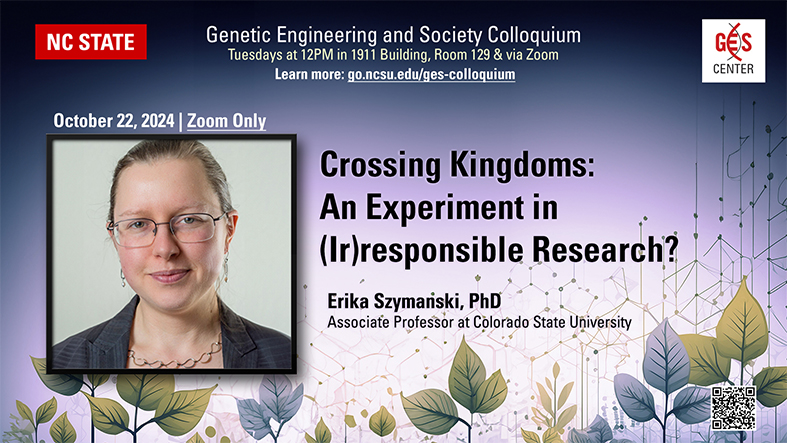
Erika Szymanski – Crossing Kingdoms: An Experiment in (Ir)responsible Research? | Zoom Only | GES Colloquium
Colloquium Home | Zoom Registration | GES Video Library (current) | Video Archives | Podcast | LinkedIn | Newsletter
Fall Seminar Series
Crossing Kingdoms: An Experiment in (Ir)responsible Research?
Zoom Only | An artist-led interdisciplinary experiment with risky science led to boundary-challenging conclusions about what responsibility looks like in responsible research.
Erika Szymanski, PhD
Associate Professor of Rhetoric of Science at Colorado State University | Profile
Dr. Erika Szymanski is an associate professor of rhetoric of science in the English department and the microbiome cluster, and an affiliate faculty member in the Cell and Molecular Biology program, at Colorado State University. Her research concerns words as scientific construction tools, human-microbe working relations, and multispecies questions raised by contemporary microbial biotechnologies. Her teaching interests include disciplinary and popular science writing, posthumanist theory, and humanities scholars’ roles in interdisciplinary teams.
Dr. Szymanski currently leads an NSF CAREER project called “microbiomish”, about how metaphors shape experimental approaches in microbiome science and possibilities for microbe-human coworking. She is also the US PI on a collaborative UKRI-NSF project called Future Organisms with colleagues in Edinburgh and Tokyo, about responsible research and innovation (RRI), synthetic genomics, and reimagining what “responsible research” means in more-than-human terms. Her other ongoing research involves rethinking genetic code metaphors to account for the interdependence of structural and textual information in engineering biology, the roles of microorganisms in emerging bioeconomies, and more-than-human science policy.
Abstract
Crossing Kingdoms was an experiment in (ir)responsible research. Responsible research and innovation—often abbreviated RRI—is a common framework for science governance across Europe, the UK, and elsewhere. While RRI can be expansive, it’s routinely implemented as a checklist of actions—often delegated to an early-career social scientist, who may effectively be tasked with responsibilizing a scientific project that they didn’t design and in which they have little influence.
Crossing Kingdoms was about pushing back on the notion that social scientists know how to be responsible or to make others responsible, and about questioning the responsibility of defining responsible research in such narrow terms. This artist-led research began with dangerous science—a protein from a snake virus that fuses cell membranes—and a curiosity-driven question: what place do “kingdom-crossing” yeast-mammalian fusion cells have in the world beyond the lab? The ensuing collaboration raised questions that challenged the conservativeness of how RRI is implemented: is art a good reason to do risky science? What is a good reason? How can art-science-social science research be organized for the benefit and mutual learning of all participants? What counts as an outcome? (How) do scientists and artists encourage social scientists to be responsible? Are we really crossing kingdoms, or just juxtaposing them, and why does that matter?
Since its end, the experiment has led to further projects that wouldn’t have happened otherwise: synthetic biology applications of viral protein-driven fusion in synthetic biology, artistic research into the moral value of hybrid cells, and social scientific approaches to responsibility in terms of spaces for counter-normative research trajectories. Our conclusions suggest the value of response-able research, and of doing STS with scientists rather than on or for them.
Related links:
- Szymanski, E. et al. (2020). Crossing Kingdoms: How Can Art Open Up New Ways of Thinking About Science? FBOE
- The Tissue Culture & Art Project: Crossing Kingdoms
- The Edinburgh Hub for Responsible Innovation: Building alternative practices for RRI in Japan and the UK
- The Edinburgh Hub for Responsible Innovation: Future Organisms
- Download seminar poster
The Genetic Engineering and Society (GES) Colloquium is a seminar series that brings in speakers to present and stimulate discussion on a variety of topics related to existing and proposed biotechnologies and their place within broader societal changes.
GES Colloquium is jointly taught by Drs. Dawn Rodriguez-Ward and Katie Barnhill, who you may contact with any class-specific questions. Colloquium meets weekly on Tuesdays from 12-1 pm via Zoom, with national/international guests joining us remotely, and local in-person guests every other week in the 1911 Building, room 129.
Please subscribe to the GES newsletter and LinkedIn for updates.
WordPress database error: [Unknown column 'wp_tec_occurrences.start_date' in 'SELECT']SELECT SQL_CALC_FOUND_ROWS wp_posts.*, CAST( wp_tec_occurrences.start_date AS DATETIME ) AS event_date
FROM wp_posts LEFT JOIN wp_term_relationships ON (wp_posts.ID = wp_term_relationships.object_id) LEFT JOIN wp_postmeta ON ( wp_posts.ID = wp_postmeta.post_id AND wp_postmeta.meta_key = '_EventHideFromUpcoming' ) LEFT JOIN wp_postmeta AS mt1 ON ( wp_posts.ID = mt1.post_id )
WHERE 1=1 AND wp_posts.ID NOT IN (20392) AND (
wp_term_relationships.term_taxonomy_id IN (149,150,604,802)
OR
wp_term_relationships.term_taxonomy_id IN (45,47)
) AND (
wp_postmeta.post_id IS NULL
AND
( mt1.meta_key = '_EventStartDate' AND CAST(mt1.meta_value AS DATETIME) >= '2026-03-16 10:20:19' )
) AND wp_posts.post_type IN ('post', 'page', 'attachment', 'tribe_venue', 'tribe_events', 'tribe_event_series') AND ((wp_posts.post_status = 'publish'))
GROUP BY wp_tec_occurrences.occurrence_id
ORDER BY event_date ASC, wp_posts.post_date ASC
LIMIT 0, 3