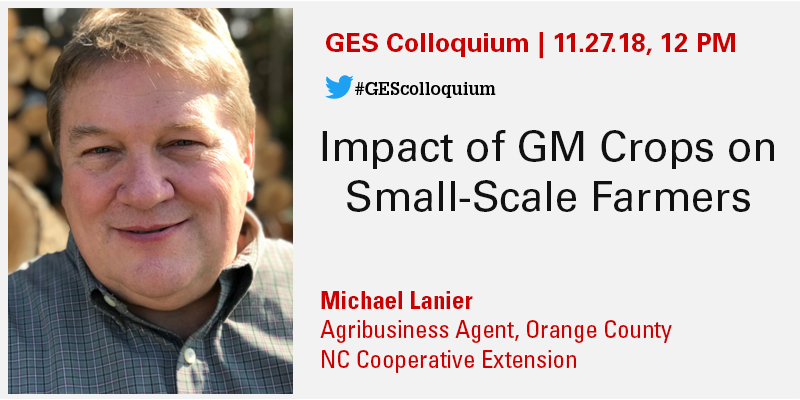
Michael Lanier – ‘Impact of GM Crops on Small-Scale Farmers’
GES Colloquium 11/27/18 - Impact of GM Crops on Small-Scale Farmers. Speaker: Michael Lanier, Agribusiness Agent, Orange County, NC Cooperative Extension
GES Colloquium 11/27/18 - Impact of GM Crops on Small-Scale Farmers. Speaker: Michael Lanier, Agribusiness Agent, Orange County, NC Cooperative Extension
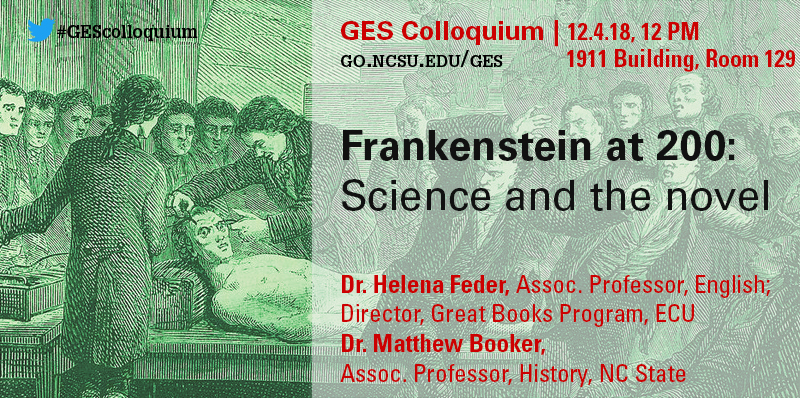
12/4/2018 Final Colloquium of Fall 2018! Feder and Booker will discuss the history of the novella, its popular uses, and ask the group to discuss the question: Why is this story so well known and so popular among scientists? What about the monster and the doctor makes Frankenstein such a powerful and accessible metaphor when scientists and the public talk about genetic modification?
GES Sisters Lunch The GES Sisters holiday lunch will be Tuesday, Dec. 11, from 12:30 - 2:00 p.m. at Gonza Tacos y Tequila, in the Aloft building, 2100 Hillsborough Street. We look forward to seeing...

Our Spring series will kick off with a catered lunch from Neomonde on Tuesday, January 08. Come prepared to give a short update about your recent GES activities and upcoming plans.
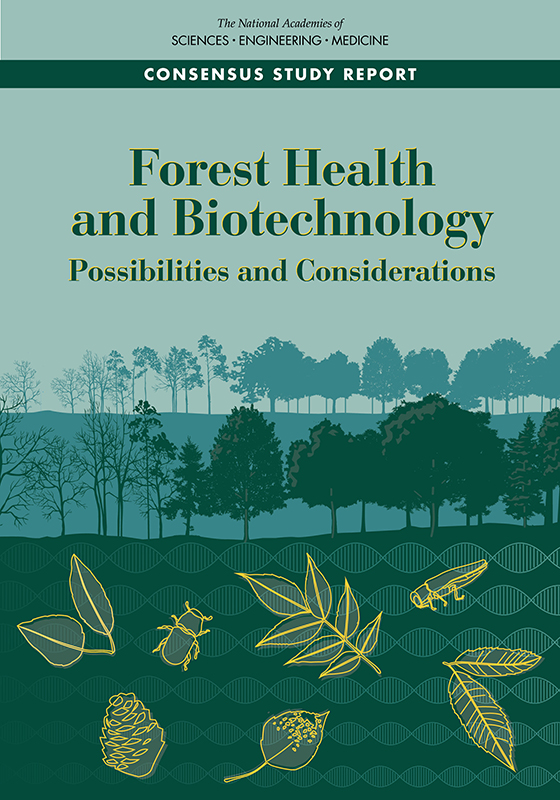
The National Academies of Sciences, Engineering, and Medicine will hold a public release webinar for the new consensus report Forest Health and Biotechnology: Possibilities and Considerations on Tuesday, January 8 at 2:00 pm ET. Register below to watch the report release webinar. The recording will be posted 1 week afterwards.
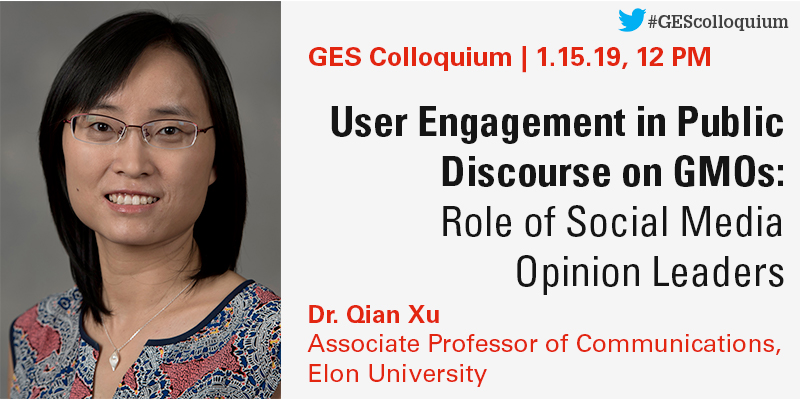
GES Colloquium, 1/15/18 - Qian Xu | This study adopted a quantitative content analysis to examine how source attributes of opinion leaders and their message framing influenced user engagement in the public discourse of genetically modified organisms on Chinese social media.
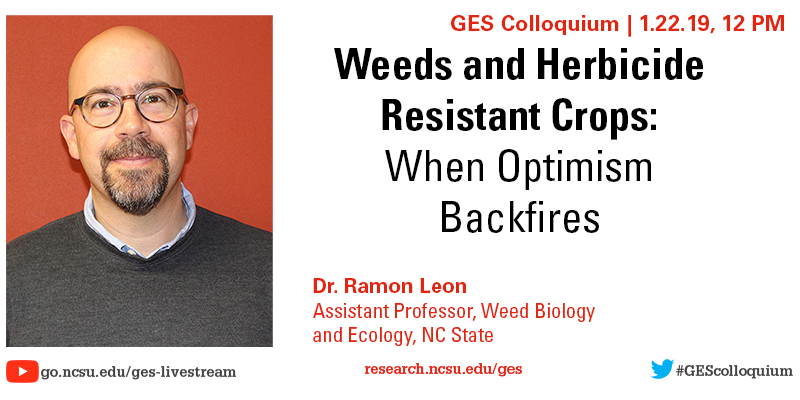
GES Colloquium, 1/22/19 - Ramon Leon | The rapid evolution of herbicide resistant weeds and the lack of new herbicides has prompted a reevaluation of how HR crops should be considered just a component within a more complex integrated management system and not as the sole tool for ensuring weed control. The excessive optimism that the agricultural and scientific community exhibited during the first years of use of glyphosate resistant crops reduced our ability to identify the limitations of the technology and the negative consequences of not taking corrective actions on time.This is a cautionary tale that should inform the introduction and use of new HR traits.
Innovative Genomics Institute, UC Berkeley, Jan 22, 2019 | Todd Kuiken Seminar: Governance of Emerging Biotechnologies in a World Without Borders. As synthetic biology, genome editing, gene drives, CRISPR, and the biotechnologies of tomorrow continue to emerge, international treaties are struggling to keep pace. While recognizing that biotechnologies are rapidly developing, with potential benefits and potential adverse impacts; how will treaties develop governance systems to both enable benefits while preventing or minimizing adverse effects? How do international treaties that address access and benefits sharing agreements based on “physical genetic material” incorporate (or not) digital sequence information? If engineered gene drives do not recognize a country’s or indigenous community’s sovereign lands; how does the international community address a situation where one country decides to move forward while another, or indigenous community, says no? And how does the International Union for Conservation of Nature, the global authority on the status of the natural world and the measures needed to safeguard it, incorporate (or not), the tools of biotechnology? These are just some of the complicated questions international treaties have been debating over the last 10 years. Join us for a discussion as I examine these and other issues through my personal experiences inside these debates.
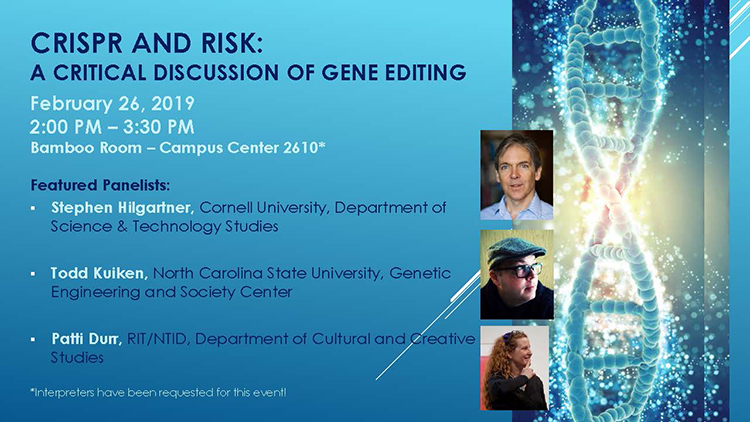
CRISPR and RISK - A Critical Discussion of Gene Editing; Rochester Institute of Technology, Feb 26, 2019. Speakers: Stephen Hilgartner, Cornell University, Department of Science and Technology Studies; Todd Kuiken, Senior Research Scholar, Genetic Engineering and Society Center North Carolina State University; Patti Durr, RIT/NTID, Department of Cultural and Creative Studies
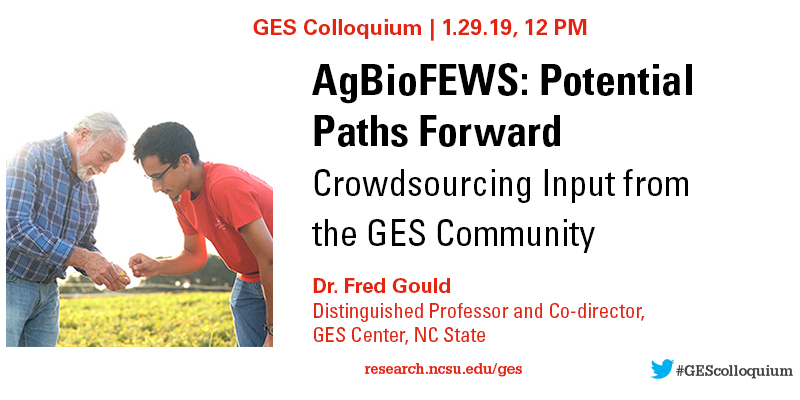
GES Colloquium, 1/29/19 - Fred Gould | The GES Center is launching our new NSF-funded Research Traineeship, Agricultural Biotechnology and Our Evolving Food, Energy, and Water Systems, or AgBioFEWS. We are in the process of recruiting our first cohort of students and designing details of our courses. We would like to use this colloquium to get feedback from students on faculty on a choices that we will be making.
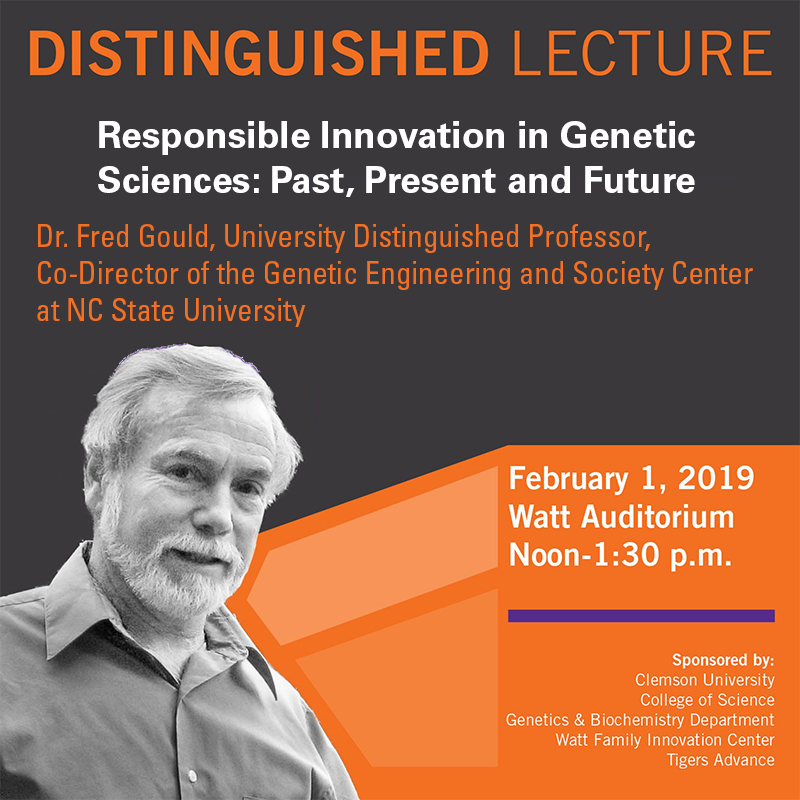
Clemson University, Feb. 1, 2019 | Dr. Gould has served on National Research council committees, addressing regulation of genetic technologies in agriculture. Dr. Gould received the Alexander von Humbodlt Award for most significant agricultural research over a fiver-year period, the Sigma Xi George Bugliarello Prize for written communication of science, and the O. MAx Gardner Award in 2012 for being the UNC faculty member with the greatest contribution to human welfare. He was elected to the US. National Academy of Sciences in 2011 and serves on the National Research Council Board on Agriculture and Natural Resources.
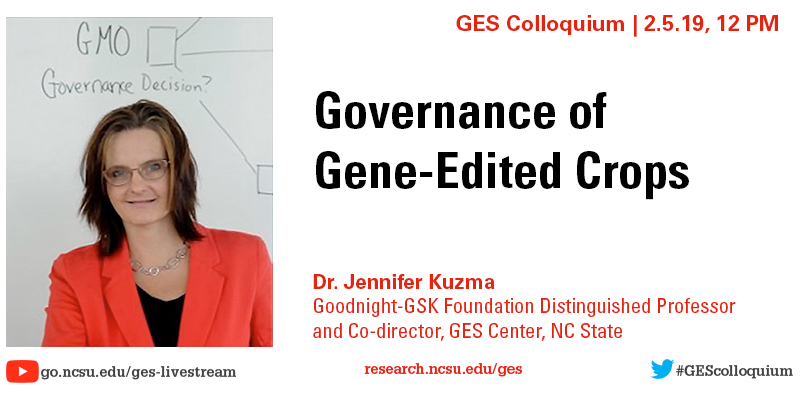
GES Colloquium, 2/5/18 - Jennifer Kuzma | Crop gene editing emerged just over a decade ago as a promising set of biotechnology techniques designed to more quickly and precisely introduce new or altered genes to change plant characteristics for better growth, product quality, processing, nutrition, or sustainability. Scientists in academia and the ag-biotech industry alike are promoting gene editing, through techniques such as CRISPR-Cas9, as the start of a second biotechnology revolution in agriculture.