
The Problems Driving Resistance to Bt Crops—and Some Proposed Solutions
By: DOMINIC REISIG, Entomology Today | Bt crops—those genetically engineered to produce an insecticidal toxin from the bacterium Bacillus thuringiensis—are special due to their benefits: reducing foliar insecticide applications, which increase populations of beneficial insects and minimize environmental harm; reducing pest populations throughout the landscape; and preserving yield, to name a few. Therefore, preventing resistance to Bt crops is important and is usually formalized in a set of Insecticide Resistance Management (IRM) practices. Because bollworm is now resistant to two Bt toxin families in cotton, IRM practices may have to change to slow resistance to other Bt toxins....Continue reading "The Problems Driving Resistance to Bt Crops—and Some Proposed Solutions"
Report: Biotechnology, the American Chestnut, and Public Engagement
In April 2018, a team of NC State faculty and students convened a stakeholder workshop to explore opportunities for public engagement surrounding the development, regulatory review, and potential deployment of a genetically engineered American chestnut tree. As perhaps the first GMO designed to spread and persist in the wild, the tree has the potential to restore a functionally extinct species, but also raises important ethical, political, ecological, and cultural questions. This report describes the workshop and its purpose, details the substance of the discussions, and offers the research team’s perspective on lessons learned and ways forward....Continue reading "Report: Biotechnology, the American Chestnut, and Public Engagement"

‘Changing the Landscape of Graduate Education’
GES Center to launch NSF-funded AgBioFEWS graduate program, blending natural and social sciences to train next-gen problem-solvers in agricultural biotechnology....Continue reading "‘Changing the Landscape of Graduate Education’"

Gould quoted in C&EN: Building bioethics into the future of life sciences innovation
Scientists who refuse to engage with ethicists and the public will find themselves at a disadvantage. “Just because you are a scientist and have invented something doesn’t mean you have authority over it,” says Fred Gould, an entomologist and co-director of the Genetic Engineering & Society Center at North Carolina State University. He points to the National Academies report’s advocacy of participatory decision-making. Resistance from the science community based on ethicists and the public not fully understanding the science wears thin, he says. “You are a pretty poor scientist if you can’t explain what these things are about to an ethicist,” he says....
NBC News – Gould: Exposure levels determine toxicity of glyphosate
“With all things, it is the level of exposure that matters,” said Fred Gould, head of the Genetic Engineering and Society Center at North Carolina State University. “The poison is in the concentration.”...Continue reading "NBC News – Gould: Exposure levels determine toxicity of glyphosate"
Washington Post: Kuzma calls for mandatory regulatory process for gene-edited foods
“We need a mandatory regulatory process: not just for scientific reasons, but for consumer and public confidence,” Kuzma said. “I think the vast majority of gene-edited foods are going to be as safe as their conventionally bred counterparts. But I don’t buy into the argument that’s true all the time for every crop.”...
Call for art for 2019 “genetic futures” exhibit
open call for art | 2019 Genetic Futures exhibit | Now accepting proposals from artists, scientists, designers, and makers. The NCSU Libraries, NC State’s Genetic Engineering and Society Center (GES), and the Gregg Museum of Art & Design have issued a public call for art for the upcoming exhibition Art’s Work in the Age of Biotechnology: Shaping our Genetic Futures....Continue reading "Call for art for 2019 “genetic futures” exhibit"
Publication: How social science should complement scientific discovery: lessons from nanoscience
Dr. David Berube, Professor of Science and Technology Communication, and GES Center affiliate, has published the following article in the Journal of Nanoparticle Research. How social science should complement scientific discovery: lessons from nanoscience CITE AS: Berube,...
Genome Editing in Agriculture – CAST Issue Paper
PRESS RELEASE: July 9, 2018. Twentieth-century advances in plant and animal breeding did much to help meet the increasing food, fiber, feed, and fuel needs of an expanding world. But continued population growth, resource shortages, climate change, and pest prevalence make sustainability a daunting yet essential task. Genome editing is a powerful new method that enables unprecedented control over genetic material and offers the opportunity to make rapid advances that influence agricultural practices....Continue reading "Genome Editing in Agriculture – CAST Issue Paper"

Kuzma quoted on ecological impacts and regulation of GE products
To critics, the case laid bare glaring weaknesses in the country’s oversight of genetically engineered, or GE, crops. While biotechnology’s defenders say the process is already overly rigorous, others have long argued that regulations, which haven’t changed significantly since 1987, don’t do enough to protect agriculture and the environment. Neither the USDA nor any government agency must weigh the full social, economic and ecological impacts of GE products, says Jennifer Kuzma, co-director of the Genetic Engineering and Society Center at North Carolina State University. “There’s really no place that’s looking at this broadly from a risk-benefit perspective.”...Continue reading "Kuzma quoted on ecological impacts and regulation of GE products"

Kuzma in Scientific American article: Weeds Are Winning in the War against Herbicide Resistance
Herbicides are under evolutionary threat. Can modern agriculture find a new way to fight back? Excerpt: For farmers, protecting fields from pests and plagues is a constant battle fought on multiple fronts. Many insects have...
Publication: Comparative, collaborative, and integrative risk governance for emerging technologies
GES Co-director, Dr. Jennifer Kuzma and affiliated faculty member, Dr. David Berube, have published an article in the journal Environment Systems and Decisions that argues for a risk governance approach to emerging technologies, such as synthetic biology...
SciLine Briefing: Jennifer Kuzma on Gene Drives
VIDEO: GES Center Co-director Jennifer Kuzma recently participated in SciLine’s first Media Briefing on Gene Drives. Date recorded: April 25, 2018 About This Media Briefing: Gene drives represent a new take on genetic engineering offering...Continue reading "SciLine Briefing: Jennifer Kuzma on Gene Drives"
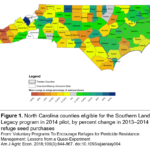
Publication: Voluntary Programs To Encourage Refuges for Pesticide Resistance Management
Dr. Zack Brown, assistant professor of agricultural economics and GES Center Executive Committee member, has published an article in the American Journal of Agricultural Economics which examines the implications of using behavioral approaches to managing pesticide...