Scott Lab Research Featured During Visit from Central American Officials
Written by Melinia Florez-Cuadros At NC State, Dr. Max Scott and his lab are engineering transgenic strains of sheep blowfly, which is a pest species in Australia but also serves as model system for the New...Continue reading "Scott Lab Research Featured During Visit from Central American Officials"

Funders respond to NASEM Gene Drive study
Funders of the National Academy of Sciences consensus study Gene Drives on the Horizon (2016) have published a response to the report in the December 2017 issue of Science. The study summarized "current understanding of the scientific discoveries related to gene drives and their accompanying ethical, legal, and social implications," and was co-authored by Dr. Jason Delborne, associate professor of science, policy and society in the College of Natural Resources and executive committee member of the GES Center....Continue reading "Funders respond to NASEM Gene Drive study"

Jason Delborne appointed to National Academies Forest Biotech Study Committee
Dr. Jason Delborne has been appointed to the National Academies of Sciences provisional committee on The Potential for Biotechnology to Address Forest Health, or Forest Biotech Study. The study will be looking at the potential uses of biotechnology to mitigate threats to forest tree health, identify ecological, ethical, and societal implications of using this technology in forests, and develop an agenda to address knowledge gaps in its application. ...Continue reading "Jason Delborne appointed to National Academies Forest Biotech Study Committee"
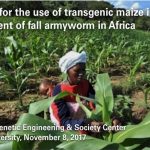
Genetic Engineering may not solve Africa’s fall armyworm problems
The fall armyworm which is a major pest of corn in the western hemisphere has become an invasive pest in Africa in the past few years. Some groups are calling for use of Bt corn as a solution. In this video Dr. Gould describes why it would take great dedication and large resources in money and people to use this approach in an equitable and sustainable manner....Continue reading "Genetic Engineering may not solve Africa’s fall armyworm problems"

Jason Delborne addresses CRISPR gene drives controversy in NYTimes, Quanta, and Gizmodo
GES Faculty member Jason Delborne addresses two controversial new papers in several articles published this week on the safety of field testing CRISPR gene drives in the wild. With links to articles in New York Times, Quanta, Gizmodo and The Atlantic....
IGERT Student Jennifer Baltzegar wins Entomology poster contest
Jennifer Baltzegar, a PhD Candidate in the Genetics Program, won first place in a research poster competition last week at the Entomological Society of America’s 2017 Annual Meeting. Jen is an NSF IGERT Fellow in Genetic...Continue reading "IGERT Student Jennifer Baltzegar wins Entomology poster contest"

Scientific American: Could Genetic Engineering Save the Galápagos?
Campbell first became intrigued by the possibilities of gene drive in 2011, when he sat in on a conference call between biologists at NC State University and officials of the U.S. Fish and Wildlife Service to discuss a possible genetic approach to control a runaway mouse problem on Southeast Farallon Island, about 20 miles west of the California coast, near San Francisco. John Godwin, a North Carolina State neurobiologist who studies animal behavior, had learned of the Farallon issue while skimming the Internet in 2011. He happened to be at a university with an established infrastructure dedicated to experimenting with—and considering the ethical implications of—genetic manipulation....Continue reading "Scientific American: Could Genetic Engineering Save the Galápagos?"
IGERT Student Jessica Barnes wins poster contest at 2017 American Chestnut Foundation meeting
Read about the ACF Annual Meeting and see more photos here. Full poster (click to enlarge)...
Scientific American article on public acceptance of CRISPR features Delborne and Kuzma
“Without transparency, we might see a kind of hyperpolarization,” says Jason Delborne, a professor of science, policy and society at North Carolina State University. Concerned groups will feel marginalized, and advocates won't receive critical feedback needed to improve design and safety. “This puts the technology at risk of a knee-jerk moratorium at the first sign of difficulty,” he notes....
Upgrading Biosafety and Biosecurity: Open Philanthropy awards $700K for DIYbio
“For the last six years, Todd and I have been exploring the best ways to ensure the healthy growth of community labs as safe and secure resources for public education and biotech innovation,” says Grushkin. “This grant will help us codify best practices in these often unconventional spaces.”...Continue reading "Upgrading Biosafety and Biosecurity: Open Philanthropy awards $700K for DIYbio"
Kuzma examines benefits, regulation of gene edited crops in EMBO
In this article, published by EMBOpress, researchers look at how new genetic-engineering (GE) technologies based on gene editing can help to generate crop varieties to address critical challenges in agricultural development. However, governance systems for these crops are poorly defined and currently uncertain....Continue reading "Kuzma examines benefits, regulation of gene edited crops in EMBO"
GES IGERT Students Research Deployment of Gene Drive Insects
A new paper from GES IGERT students, to be published by the Journal for Responsible Innovation, is now available online. Anticipating complexity in the deployment of gene drive insects in agriculture Jennifer Baltzegar, Jessica Cavin Barnes, Johanna E. Elsensohn, Nicole Gutzmann, Michael...Continue reading "GES IGERT Students Research Deployment of Gene Drive Insects"

NC State Receives DARPA Funding to Develop, Test Gene Drive System
For Immediate Release August 3, 2017 John Godwin | 919.513.2936 North Carolina State University researchers have received funding from the Defense Advanced Research Projects Agency (DARPA) to develop and test a system that would reduce populations of...Continue reading "NC State Receives DARPA Funding to Develop, Test Gene Drive System"
Overcoming Challenges to Infusing Ethics into the Development of Engineers: Proceedings of a Workshop (2017)
While all technologies have societal and ethical implications, emerging technologies (e.g. artificial intelligence and genetic engineering) often pose unique ethical challenges. As advances are made in the fields of engineering, it is vital that issues...
Synthetic Microorganisms for Agricultural Use
By 2050, the world’s population is estimated to exceed 9 billion people. A challenge to this rising food demand is that crops will have to be grown on the same or less land as today. Additionally, global climate change is causing considerable uncertainty in the ability of the current food production system to adapt to an unknown future. To address these issues sustainably, scientists from many disciplines have been investigating ways to increase crop yields and prepare for a changing climate. Considerable effort has focused on enhancing the traits of the crop plants themselves, to enhance their growth, make them resistant to disease, or tolerant to environmental stressors like drought or high salinity conditions. Conversely, a growing area of research is looking at how microorganisms, such as bacteria and fungi, influence these plant characteristics....Continue reading "Synthetic Microorganisms for Agricultural Use"