Discussion Session: The Biotechnology Executive Order | GES Colloquium
This Colloquium is dedicated to reviewing the recent Executive Order on Advancing Biotechnology and Biomanufacturing Innovation released on September 12, 2022....Continue reading "Discussion Session: The Biotechnology Executive Order | GES Colloquium"
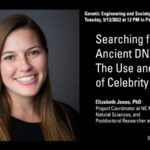
Elizabeth Jones – Searching for Ancient DNA: The Use and Abuse of Celebrity | GES Colloquium
Ancient DNA research has a short but sensational history, especially as the birth of the field coincided with the Jurassic Park craze. Find out how celebrity helped shape the science for better or for worse....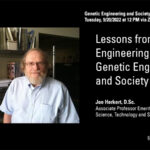
Joe Herkert – Lessons from Engineering Ethics for Genetic Engineering and Society | GES Colloquium
ZOOM MEETING: A discussion of key concepts of engineering ethics scholarship and teaching that might be useful in thinking about ethics in the context of genetic engineering and society....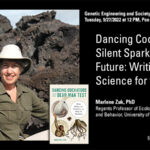
Marlene Zuk – Dancing Cockatoos, Silent Sparks and the Future: Writing About Science for the Public | GES Colloquium
Writing about science for the public is fun, and hard, and requires some skills you may not regularly use as a scientist....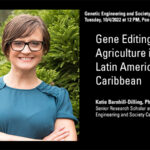
Katie Barnhill-Dilling – Gene Editing for Agriculture in Latin America & the Caribbean | GES Colloquium
A broad overview of the GES Center project (funded by the InterAmerican Development Bank) that has explored the relevant policy and capacity for developing gene edited crops in Latin America and the Caribbean....
Steve Lindow – Understanding Microbial Life on Leaves | GES Colloquium
Bacteria that live on leaf surfaces play important roles ranging from global precipitation to plant health...Continue reading "Steve Lindow – Understanding Microbial Life on Leaves | GES Colloquium"
Nicholas Jordan – Gene Editing for Agricultural Diversification? | GES Colloquium
Gene editing as a tool for agricultural diversification: perspectives from a multi-sector deliberative group....Continue reading "Nicholas Jordan – Gene Editing for Agricultural Diversification? | GES Colloquium"
Becky Goldburg – Supporting Actionable Research That Informs Conservation | GES Colloquium
How Pew's approaches increase the likelihood that research is applied in real world conservation decisions....
Ben Novak – Biotechnologies for Conservation and Their Intended Consequences | GES Colloquium
IN-PERSON COLLOQUIUM. Revive & Restore's "Intended Consequences" initiative aims at rebalancing the risk-benefit equation around the use of biotechnologies in conservation practices....3/29 GES Colloquium Cancelled
Statement regarding cancellation of the upcoming Colloquium on March 29, Panel: Narratives and Storytelling in the Public Communication of Science and Technology...
Faith Kearns – Getting to the Heart of Science Communication | GES Colloquium
A 21st century guide to communicating science on emotional and contentious topics...Continue reading "Faith Kearns – Getting to the Heart of Science Communication | GES Colloquium"
Florence Wambugu – Pioneering Work in Genetic Engineering of Crops and It’s Adoption in Africa | GES Colloquium
Factors influencing the adoption of GE crops in Africa, and Dr. Wambugu's pioneering work on GE sweetpotato and with the Africa Biofortified Sorghum (ABS) project. ...
Developing a Research Agenda for BE CCS Crops – AgBioFEWS Cohort 2 Group Project | GES Colloquium
An interdisciplinary agenda to studying the impacts of bioengineered crops for climate change mitigation...
Welcome Back Lunch | GES Colloquium
The Genetic Engineering and Society Colloquium is a seminar series that brings in speakers to present and stimulate discussion on a variety of topics related to existing and proposed biotechnologies and their place within broader societal changes....